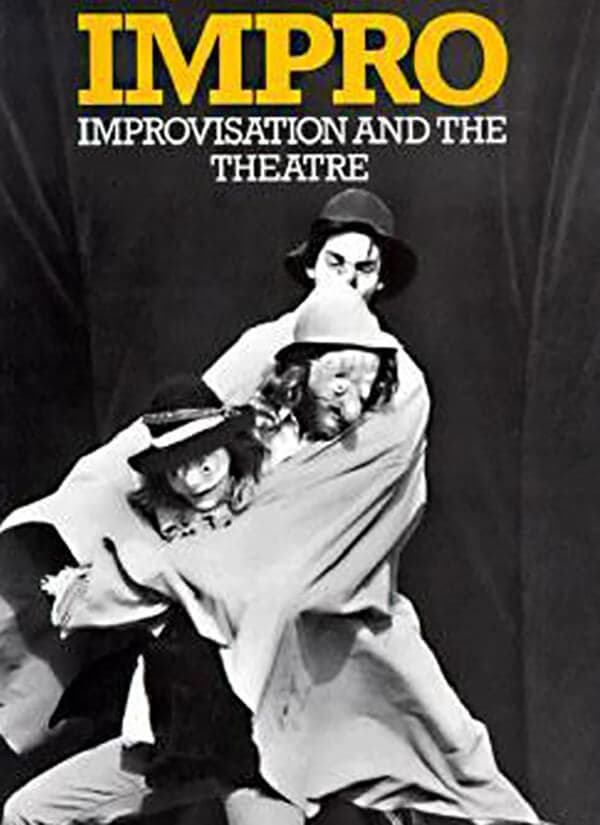
Details:
The problem:
Most adults freeze when asked to create - to tell a story, sketch an idea, write a line. The block doesn’t come from a lack of imagination but from fear. We’ve been taught that what we produce reveals who we are. A poem becomes a confession, a drawing becomes evidence, a rough draft becomes a reflection of our inner competence. Under that pressure, many prefer silence to the risk of being “seen.”
The principle:
Keith Johnstone reframed creation not as self-expression but as transmission. Creativity, in this view, is not a message from you, but a message through you. Ancient cultures often saw artists as intermediaries: Eskimo bone-carvers believed they simply revealed the shape already hidden inside the ivory. Michelangelo said he “saw the angel in the marble and carved until he set him free.” In both, the artist’s ego is bypassed - the work arrives as if it already existed, waiting to be found.
This reframing has a liberating effect. If the story doesn’t belong to you, you are not responsible for its awkwardness, its strangeness, or its beauty. You are the medium, not the author. That separation removes the fear of judgment.
Why it works:
Neurologically, tying creativity to the self activates the default mode network (DMN) - the set of brain regions that fuel self-referential thinking and rumination. When the DMN dominates, people hesitate, censor, and critique prematurely. But when creativity is externalised - when it is “coming through” rather than “from” - the evaluative loop quiets. Associative networks in the temporal lobes can then connect distant concepts more freely, and the prefrontal cortex allows unusual combinations to survive long enough to surface.
This aligns with flow-state research: peak creativity occurs when self-conscious monitoring diminishes, and the brain shifts from evaluation to generation. The paradox is that when you stop trying to express yourself, the originality you feared losing actually arrives more readily.
Why it’s difficult:
Western education and culture enshrine the Romantic myth of the artist as tortured self-expressor. From childhood, we are taught that art is autobiography, that the value of a poem or painting lies in how directly it reveals the soul behind it. A child’s surreal story is taken at face value until adolescence, when suddenly it becomes evidence of psychological disturbance. This interpretive pressure makes teenagers - and later adults - censor themselves, cutting off the very spontaneity they once had.
How to try it:
Johnstone devised exercises to bypass ego. When a student claimed she couldn’t invent a story, he told her to guess a story he had in mind. She asked questions; he answered yes or no according to an arbitrary rule (say “yes” to anything ending with a vowel). Without realising it, she built an entire narrative - but because she believed the responsibility lay with him, her imagination poured forth.
You can replicate this. Start a draft by pretending you are transcribing for someone else - a ghost, a god, an algorithm, a character. Speak their words rather than your own. Or set an arbitrary rule - every line must begin with “Because” - and follow it until a story appears. These techniques create a cognitive sleight-of-hand: your critical brain thinks “this isn’t me,” which frees the generative brain to supply material.
The easier version:
If “ghost dictation” feels too contrived, try distancing your ownership by saying, “I’m just playing with this.” Even that small linguistic shift reduces self-identification with the outcome. Write badly on purpose, as though you’re generating scrap for someone else to polish. The key is loosening the tie between self and product.
The broader implication:
Treating creativity as something that flows through you reframes the entire endeavour. It restores humility because you are a conduit, not the source. It reduces anxiety - errors are not self-indictments. And it accelerates output, because when you stop guarding your identity, you can finally release your imagination.
✨ In short:
Creativity is less like mining your soul than tuning a radio. The station is already broadcasting; your job is to receive it clearly. When you stop straining to make the signal “about you,” the static falls away, and the music plays.