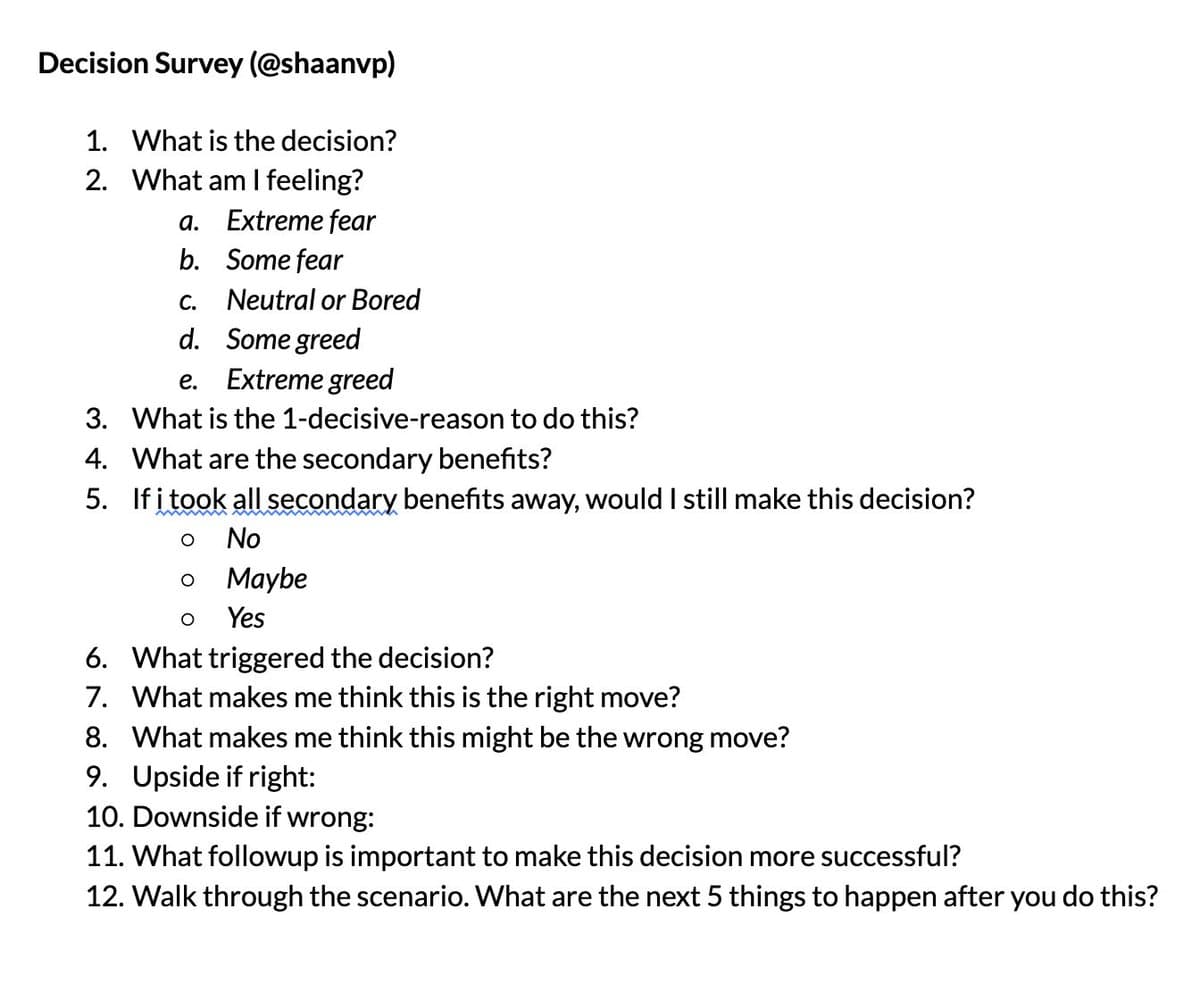
Details:
Shaan uses his decision matrix to record his thought process after making a decision, with one goal in mind - train the most important muscle - judgement.
Shaan Puri’s 12-point checklist forces a pause and runs your idea through four filters:
1. Emotional scan – naming the feeling (fear, greed, boredom) pulls the amygdala out of the driver’s seat and hands the wheel to the prefrontal cortex.
2. Single decisive reason – if you can’t state one core rationale, you don’t have a rationale.
3. Secondary-benefit strip-test – remove the perks; would you still do it? A clean “yes” signals real conviction.
4. Upside / downside / next-five-steps – quantifies risk, imagines follow-through, and turns a hunch into a plan.
Neuroscience backs the method: structured reflection like this reduces outcome-regret and overconfidence bias (Koriat & Goldsmith, 2013) while boosting decision satisfaction (Larrick et al., 1995).
Extra questions worth adding:
13. What specific metric will tell me in 90 days if this was a win or loss? - (Sets a measurable success flag and curbs moving the goalposts.)
14. Who’s already solved a similar problem, and what did they learn? (Injects borrowed experience; lowers blind-spot risk.)
15. If I had to reverse this decision in six months, how painful would it be - in time, money, credibility? (Surfaces exit costs; discourages one-way doors.)
16. What’s the smallest, cheapest experiment that would give me real data? (Pushes you toward a reversible micro-test before a full-scale leap.)
17. Who will be directly affected, and have I asked for their perspective? (Adds a stakeholder check; prevents tunnel vision.)
Complete the survey, tack on any extras that fit your context, and you’ll have a clearer head, a concrete risk-map, and - not least - a written record you can revisit when future-you asks, “What was I thinking?”