Details:
The problem:
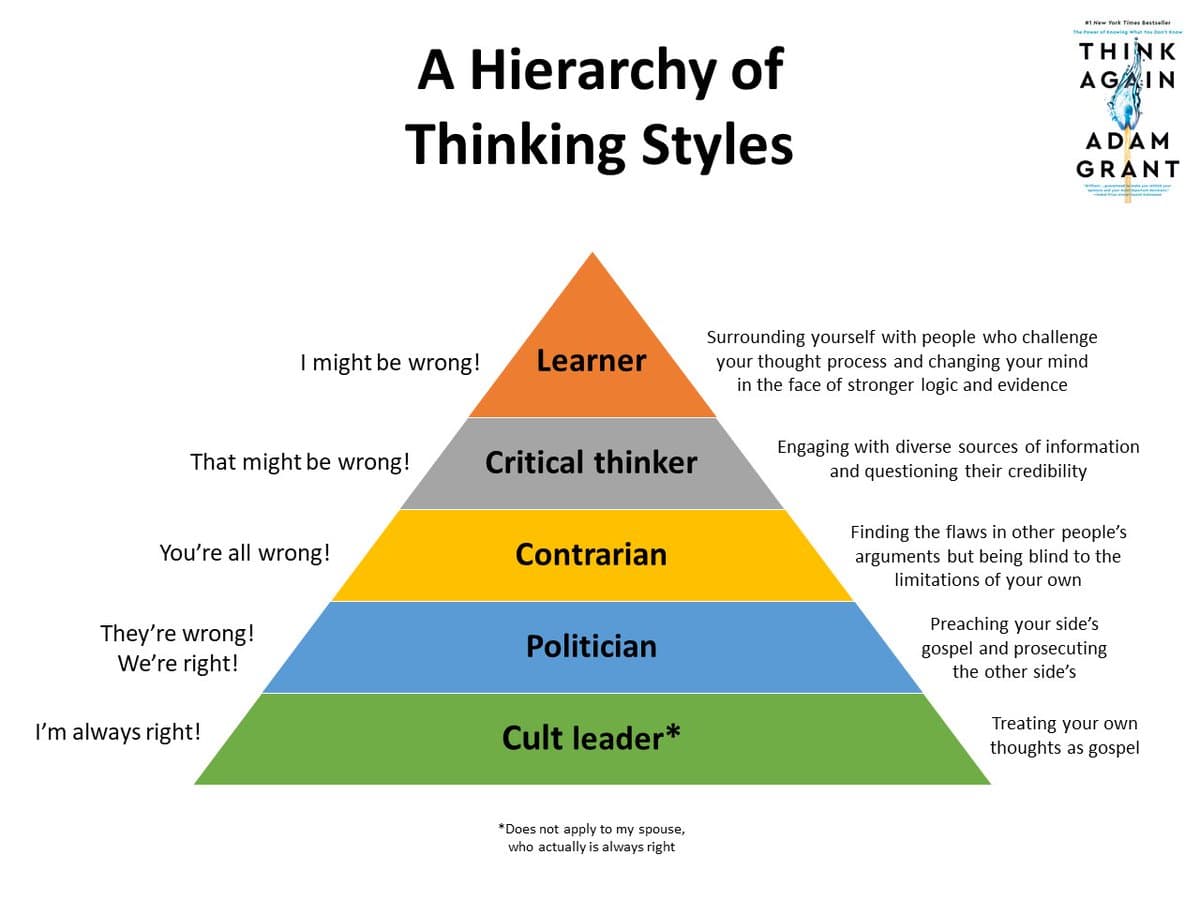
Most of us cling to our beliefs not because they’re flawless but because they’re familiar. We defend them like possessions. The danger, Grant warns, is that when you treat your opinions as gospel, you stop updating them. Learning stalls.
The principle:
One of the clearest signs of growth is the ability to rethink - to revisit assumptions, revise opinions, and change course in the face of stronger logic or evidence. The hierarchy he sketches makes this clear: the “learner” isn’t the person who always has the right answer, but the one who’s ready to admit, “I is wrong.”
Why it works:
Cognitive science shows that belief-updating is hard because of confirmation bias - we unconsciously seek data that affirms us and discount what contradicts us. Admitting “I is wrong” disrupts that autopilot. It shifts the brain into prediction-error mode, where the anterior cingulate and prefrontal cortex work harder to reconcile gaps between belief and evidence. This discomfort is not a failure; it’s the very signal of learning.
Why it’s difficult:
Rethinking threatens identity. If you’ve built status on being “the expert” or “the certain one,” entertaining doubt feels like weakness. Socially, admitting uncertainty can feel like ceding ground. The irony is that people who display flexibility are usually trusted more, not less, because they show they’re anchored in truth, not ego.
How to try it:
1. Once a week, write down one assumption you hold strongly. Ask: “What evidence would change my mind?”
2. Seek out one person who reliably disagrees with you, and invite them to stress-test your view.
3. When you catch yourself saying “I know,” replace it with “Here’s what I think, and here’s what could change it.”
4. In conversation, practise the learner’s phrase: “I is wrong.” Say it aloud - it reconditions your own reflexes as much as it reassures others.
A caution:
“I is wrong” should never be a throwaway line to sidestep discomfort or shut down debate. Deflective humility - conceding too quickly just to move on - cheats you of growth as much as stubborn certainty. The point is to engage with the evidence and wrestle with the tension. Only then does rethinking do its work.
The broader implication:
Knowledge isn’t static. The people who grow aren’t the ones who nail every answer on the first try but the ones willing to revise their map as new terrain appears. To rethink is not to weaken your position - it is to stay aligned with reality as it shifts under your feet.